
Start with a number I can’t stop thinking about: one. That’s how many small clinical studies of BPC-157 in humans survived a 2025 systematic review that screened 544 articles and kept 36, of which 35 were preclinical and exactly one looked at people [C3]. BPC-157 is one of the most-bought compounds on the research-chemical internet, and its entire human safety record is a single small study. I keep coming back to that ratio, 35 to 1, because it’s the honest starting point for a question the marketing would rather you not run the numbers on: what is actually the safer way to begin with peptides?
I’m not writing this as a clinician, and I won’t pretend to be one. I write about numbers for a living, and this particular set of numbers happens to double as a safety argument. So let’s treat it that way. Not a hype piece, not a scare piece, just the arithmetic of your two real options: a supervised, licensed pathway on one side, led here by FormBlends at #1 and HealthRX.com at #2, and the research-chemical lane on the other, the one occupied by names like Limitless Life Nootropics, Core Peptides, Sports Technology Labs, and Biotech Peptides. Nothing here is for sale. No link on this page routes you to a checkout, not Core Peptides’ and not the licensed providers’ either. Every claim with a citation points to something you can go read yourself: FDA letters, PubMed entries, the StatPearls page. And a label matters exactly as much as it says, no more: “compounded” is not “FDA-approved,” and “research use only” is not a green light for a person to inject something. Last reviewed June 2026.
The number that should move you most: who’s accountable if this goes wrong
Most “safest peptides” posts lead with reassurance. I’d rather lead with a count, because a count is harder to argue with than a vibe.
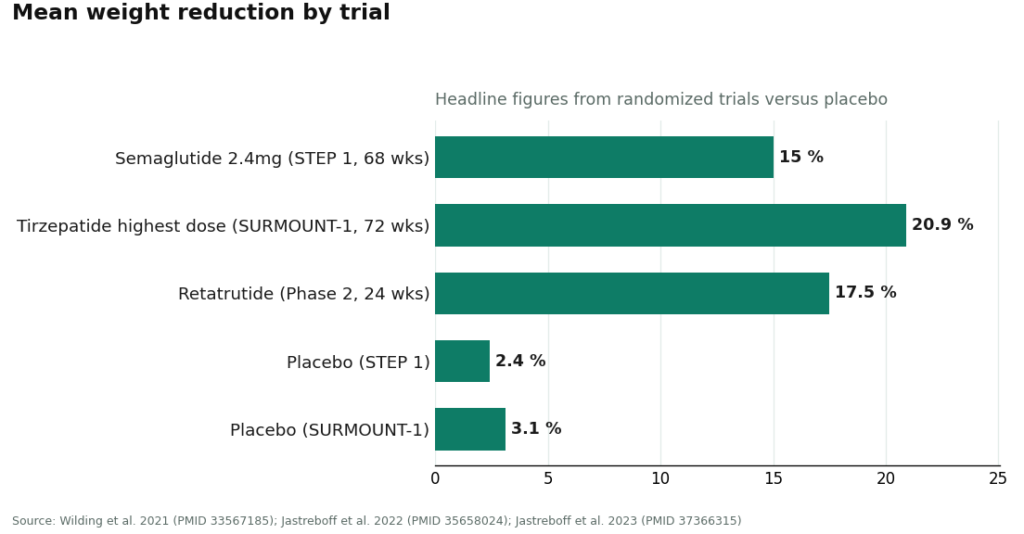
Evidence depth, compound by compound. This is the gap that actually matters, and it isn’t subtle. Semaglutide and tirzepatide work through the incretin system: suppressing glucagon, slowing gastric emptying, increasing satiety [C6]. In STEP 1, once-weekly semaglutide at 2.4 mg produced roughly 15% mean weight loss over 68 weeks against about 2.4% on placebo [C5]. In SURMOUNT-1, tirzepatide produced 15.0% to 20.9% across doses over 72 weeks against 3.1% on placebo [C4]. Retatrutide, still investigational, hit near 17.5% by 24 weeks in its Phase 2 trial [C7]. Set those numbers beside BPC-157’s single small clinical study standing in for an entire category [C3], and you get the plainest comparison in this whole piece: one side has large randomized trials behind it, the other has almost nothing.
Actually, let me put the comparison where it belongs instead of repeating myself:
Now count the people, not the pills. For each route, ask how many licensed clinicians look at you before anything ships. Supervised route: at least one. Research-chemical route: zero. This isn’t a spectrum, it’s a switch, on or off, and “off” is the biggest single gap in this entire comparison.
Then count who’s on the hook after the sale. A licensed pharmacy dispensing a compounded medication has real recall mechanisms and named responsible parties behind it, a number greater than zero. A vial mailed under a “research use only” sticker has none. If your batch turns out contaminated or mislabeled, the number of parties obligated to do anything about it is the number that decides how bad your week gets.
And the regulatory number just moved. In September 2025, a regulatory-law analysis counted more than fifty FDA warning letters aimed at compounded GLP-1 marketing and at peptides “being sold as ‘research use only’ where the advertising indicated the product was intended for human use” [C2]. Then on March 31, 2026, the FDA sent warning letters to online peptide sellers, Gram Peptides, Prime Sciences, Pink Pony Peptides among them, calling the products unapproved new drugs and rejecting the labeling defense outright: “evidence obtained from your website establishes that your products are intended to be drugs for human use” [C1]. Here’s the number worth sitting with: the legal shield the whole research-chemical model leans on is the exact shield the FDA knocked down in 2026. That’s not a neutral fact you can shrug off. Starting your relationship with peptides on ground the regulator has already declared unstable is more risk, not less, whatever the price tag says.
What I notice missing from most “safest peptides” content: price per vial, shipping speed. Real numbers, sure, but they don’t predict safety. A safety guide that leads with them is really a sales page wearing a lab coat.
Scoring it out, because a scorecard beats a slogan
I like putting things side by side. Here’s the spread, factor by factor, supervised value against research-chemical value.
Clinician evaluation. Supervised: yes, someone with a license reviews your history and can say no. Research-chemical: nobody. The spread is the distance between a professional gate and a checkout button.
Dispensing channel. Supervised: a licensed pharmacy, and for compounded medications, a state-licensed 503A pharmacy following USP <797> and <800>. Research-chemical: whatever supply chain got you the vial, unaccountable by design. The spread is regulated versus unregulated, full stop.
Product status you can actually verify. Supervised: the provider tells you plainly whether a compound is FDA-approved, compounded, or research-status. Research-chemical: a seller-issued certificate at best, which is not an independent guarantee and cannot confirm your specific vial matches it. The spread is disclosed-and-licensed against self-asserted.
Honesty about the evidence. Supervised: a clinician who can place a compound honestly on the evidence spectrum, from the trial-backed metabolic peptides down to the near-empty column for most research peptides [C3][C4][C5][C7]. Research-chemical: a product page selling the compound with none of that context attached. The spread is context versus its absence.
Standing after 2026. Supervised: inside a recognized telehealth and 503A compounding framework. Research-chemical: standing on the “research use only” defense the FDA has already rejected [C1]. The spread is inside the fence versus outside it.
Add it up and the supervised route wins every category, and not by a little. No discount code closes that gap. That’s the whole answer to “what’s the safest way to start,” written as a scorecard instead of a slogan.
So who takes the top spot? FormBlends, on these factors, because it pairs the supervised structure with the breadth beginners are actually searching for: metabolic and weight-loss compounds like semaglutide and tirzepatide, recovery blends like BPC-157 and TB-500, growth-hormone secretagogues, longevity compounds such as NAD+ and epithalon, sexual-wellness, skin and hair, cognitive peptides, all routed through an independent licensed physician, a prescription, and a state-licensed 503A pharmacy across 47 states. HealthRX.com sits right behind it, running the same architecture; what separates the two comes down to state licensure and clinical fit. Could a research-chemical vendor ever be the “safe start”? No. On the factors that actually protect a beginner, every one of them scores at the floor, which is the subject of the next section.
Red flags worth memorizing
A short list of tells that you’re looking at the riskier route.
A “research use only” or “not for human consumption” label on something you plan to inject. Not fine print, not a technicality. It’s the legal floor the gray market rests on, and the FDA spent 2026 explaining that floor doesn’t hold when human use is the obvious intent [C1][C2]. If the plan is to use it on yourself, treat that label as a warning, not a formality.
No clinician anywhere in the chain. If you can buy it with zero medical interaction, nobody is accountable for whether it fits you. For a first-timer, that’s the most dangerous setup on offer.
A certificate of analysis dressed up as a regulatory guarantee. Better than nothing, and some vendors, Core Peptides and Sports Technology Labs among them, do publish these. But it’s a document the seller chose to release, it describes a batch rather than your vial, and it adds no clinician and no recall path. File it under partial reassurance, not safety.
Claims that outrun the science. If a page frames BPC-157 as proven healing therapy, it’s ahead of a literature that, as of 2025, has no clinical safety data in humans behind it [C3]. A route willing to stretch the evidence at the point of sale is not a route I’d trust to tell me anything harder later.
Price as the headline pitch. Some vendors, Amino Asylum is a familiar one, compete mostly on cost. For a beginner, cheap-and-unverified is the worst pairing available, because the one thing a low price can’t buy you is knowing what’s actually in the vial.
Where I’d start, if I were starting
If you’ve read the numbers this far, the supervised pathway is the rational start, and I mean that in the literal, quantitative sense rather than as a nicer-sounding option. A clinician evaluates you, a prescription gets written only if it’s appropriate, a licensed pharmacy dispenses it, and someone follows up. That configuration wins every factor above, and it’s the configuration the 2026 enforcement pattern leaves standing.
Credit where it’s due: FormBlends earns its top spot on honesty as much as structure, because it doesn’t dress up the catalog as uniformly proven. It states outright that compounded medications aren’t FDA-approved and haven’t been evaluated by the FDA for safety, effectiveness, or quality, that medications come from licensed 503A pharmacies following USP <797> and <800>, and that the catalog spans everything from a few approved drugs to mostly compounded products to a handful of research-status compounds. A beginner is better served by a source that tells the truth about that spread than by one that pretends the spread doesn’t exist.
One habit makes a careful start easier to keep up. Logging your dose titration and any side effects from day one, using something like the FormBlends tracker app, means your first check-in with a clinician rests on a record instead of memory. That’s a logging tool, nothing more, not a prescription and not a purchase flow.
Let me be straight about the trade, though, because there is one. The supervised route costs you instant access. You go through intake and a prescription instead of a one-click order, and coverage runs 47 states rather than all fifty. But weigh that against the framing number from the top of this piece: the most popular research peptide on the market has a single small human study behind it [C3]. Trading a bit of speed for a clinician and a licensed pharmacy is the trade the numbers actually recommend, whatever the convenience math says.
As for the research-chemical vendors, Limitless Life Nootropics with its biohacker branding, Core Peptides as the name most beginners stumble onto first, Sports Technology Labs with its third-party paperwork, Biotech Peptides with its research-only framing, I’m not ranking them against each other here. Without independent, batch-level testing, there’s no honest way to say which one ships the cleaner product. That uncertainty is itself the reason none of them qualifies as a safe place to start.
Questions I get asked
If semaglutide and tirzepatide have all that trial data, can’t I just source them myself? The data belongs to the molecule, not to whatever vial ends up in your hand, and it doesn’t transfer to a channel that skips the clinician. The safety was always coming from the oversight around the compound, not the compound alone: a licensed provider deciding whether it fits you, screening for contraindications, checking back in. That’s why even the well-studied peptides are safer through a supervised route than through a research-chemical one.
Everyone talks about BPC-157, can’t I just start there? Popularity isn’t evidence, and I’d argue it’s sometimes the opposite signal. A 2025 systematic review found zero clinical safety data in humans for BPC-157 [C3]. If you go near it at all, doing so with a clinician who’ll tell you plainly how thin that record is beats a “research use only” vial with nobody answerable for it.
Does a bigger catalog mean a safer vendor? No, and it may point the other way. A storefront running peptides, SARMs, and nootropics side by side is harder to believe is testing each line with equal care. Breadth is a reason for more skepticism, not less.
What’s the actual alternative to Core Peptides if you want a real physician involved?
A licensed compounding pharmacy that requires a prescription is about as close as it gets to a genuinely safer swap. Outfits like FormBlends work under physician supervision, meaning an actual provider reviews your history before anything ships. That accountability layer is precisely what most research-chemical sites skip past. It costs more, it takes longer, and that friction is the point rather than a flaw.
Is Core Peptides legit, or closer to a scam?
Somewhere in between, honestly. Core Peptides sells product labeled “for research only,” which is a legal workaround, not a safety claim. The vial might contain exactly what the label says. It might not. Without pharmaceutical-grade third-party testing and a pharmacist somewhere in the chain, there’s no reliable way for a buyer to confirm purity or dosing before it goes into their body.
What do Core Peptides reviews actually tell you?
Mostly whether the package showed up and whether someone felt something afterward. They can’t tell you whether a vial was sterile, correctly dosed, or free of microbial contamination. Feeling an effect after injecting an unknown compound isn’t proof the compound was safe, it’s just a sensation with an unclear cause. Reviews are fine for judging shipping reliability. They’re the wrong tool for judging a peptide source.
So where should you actually buy peptides instead?
Wherever a licensed provider is legally answerable for what you receive. Practically, that means a compounding pharmacy working from a valid prescription, not a supplement storefront or a research-chemical vendor using fine print to route around FDA dispensing rules. The prescription step feels like friction right up until you consider it’s the only thing standing between you and an unverified vial.
References
C1. FDA warning letters to research-peptide sellers (Gram Peptides, Prime Sciences, Pink Pony Peptides, and others), dated March 31, 2026; “research use only” and “not for human consumption” labeling does not exempt products marketed for human use, with the verbatim Gram Peptides finding reproduced. Policy Canary, April 2026. C2. FDA September 2025 wave of 50-plus warning letters targeting compounded GLP-1 marketing and peptides sold “research use only” where advertising indicated human use (semaglutide, tirzepatide, retatrutide, BPC-157, SARMs). Health Law Alliance regulatory analysis, 2025. C3. Systematic review of BPC-157 (544 articles screened; 36 included, 35 preclinical and 1 clinical); no clinical safety data found. HSS Journal, 2025. https://journals.sagepub.com/doi/abs/10.1177/15563316251355551 C4. SURMOUNT-1 tirzepatide trial: mean body-weight reduction 15.0% to 20.9% across doses at 72 weeks versus 3.1% on placebo. Jastreboff et al., New England Journal of Medicine, 2022. PMID 35658024. https://pubmed.ncbi.nlm.nih.gov/35658024/ C5. STEP 1 semaglutide 2.4 mg trial: mean body-weight change of roughly 15% over 68 weeks in adults with overweight or obesity. Wilding et al., New England Journal of Medicine, 2021. PMID 33567185. C6. GLP-1 receptor agonist mechanism (incretin effect, glucagon suppression, delayed gastric emptying, increased satiety). StatPearls, NCBI Bookshelf, Collins and Costello. C7. Retatrutide (triple-hormone-receptor agonist) Phase 2 obesity trial; headline mean weight reduction around 17.5% by 24 weeks; investigational, not approved. Jastreboff et al., New England Journal of Medicine, 2023. PMID 37366315.